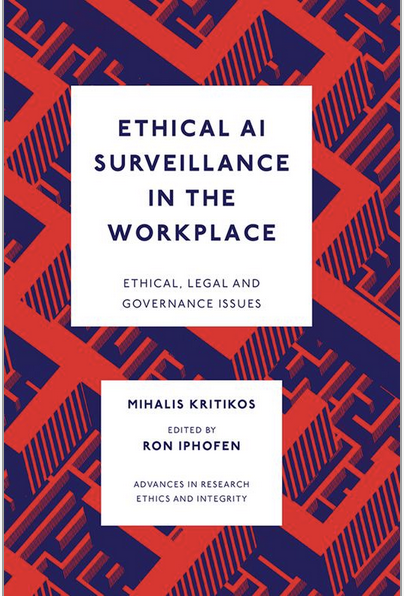
Ethical AI Surveillance in the Workplace, Volume 10 in Advances in Research Ethics and Integrity
(2023)
Mihalis Kritikos (Ron Iphofen ed.)
https://doi.org/10.1108/S2398-6018202310
So AI will lead to the end of humanity? Not if we act now to monitor and regulate – legally and ethically – its design and its applications. In our ‘Advances’ series we regularly focus on trends in research and take a topic for specific attention. We did this with the application of AI in employment settings three years ago in a monograph that proposed measures for limiting its worse effects. Employment law has been designed around traditional management structures, but AI empowered real-time workplace monitoring systems and workforce analytics software needs to be taken account of. As a result, digital workplace monitoring starts becoming stress-inducing leading to the blurring of the boundaries between public and private spheres. Practices such as the recording of computer keystroke activity and location/social media-tracking threaten to alter workplaces in fundamental ways and to undermine trust between employers and employees in today’s digital workplace. AI applications in the workplace are mushrooming and surveillance at work has also been expanded to employees working from home. Not only are these practices stress-inducing, they also pose new threats to employment rights. This volume suggests ways in which employers, employee organisations and the state can mitigate against the worst effects. It offers a model for how this could be addressed in other spheres of human activity.
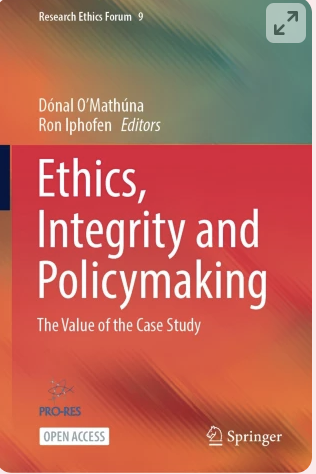
(2022) (ed. With Dónal O’Mathúna) Ethics, Integrity and Policymaking: The Value of the Case Study, Research Ethics Forum Series: Volume 9, Springer
ISBN: 978-3-031-15745-5
https://doi.org/10.1007/978-3-031-15746-2
This Open Access book provides illustrative case studies that explore various research and innovation topics that raise challenges requiring ethical reflection and careful policymaking responses. The cases highlight diverse ethical challenges and provide lessons for the various options available for policymaking. Cases are drawn from many fields, including artificial intelligence, space science, energy, data protection, professional research practice and pandemic planning. Case studies are particularly helpful with ethical issues to provide crucial context. This book reflects the ambiguity of ethical dilemmas in contemporary policymaking. Analyses reflect current debates where consensus has not yet been achieved. These cases illustrate key points made throughout the PRO-RES EU-funded project from which they arise: that ethical judgement is a fluid enterprise, where values, principles and standards must constantly adjust to new situations, new events and new research developments. This book is an indispensable aid to policymaking that addresses, and/or uses evidence from, novel research developments.

(2022) (ed. With Dónal O’Mathúna) Ethical Evidence and Policymaking: Interdisciplinary and International Research, Bristol: Policy Press
https://doi.org/10.51952/9781447363972
(download from: https://library.oapen.org/handle/20.500.12657/57173)
This important book offers practical advice for using evidence and research in policymaking. The book has two aims. Firstly, it builds a case for ethics and global values in research and knowledge exchange, and secondly, it examines specific policy areas and how evidence can guide practice. The book covers important policy areas including the GM debate, the environment, Black Lives Matter and COVID-19. Each chapter assesses the ethical challenges, the status of evidence in explaining or describing the issue and possible solutions to the problem. The book will enable policymakers and their advisors to seek evidence for their decisions from research that has been conducted ethically and with integrity.
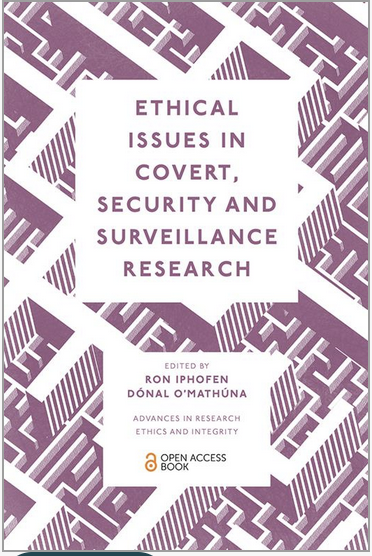
(2022) (ed. With Dónal O’Mathúna) Ethical Issues in Covert, Security and Surveillance Research, Bingley: Emerald Publishing
DOI: https://www.macmillanihe.com/page/detail/Sociology-in-Practice-for-Health-Care-Professionals/?K=9780333645765
In light of the many crises and catastrophes faced in the modern world, policymakers frequently make claims to be ‘following the science’ or being ‘governed by the data’. Yet, conflict based on inequalities continue to fuel dissatisfaction with the decisions and actions of authorities. Research into public security may require surveillance and covert observations, all of which are subject to major ethical challenges. Any neat distinction between covert and overt research is difficult to maintain given the variety of definitions used for all the terms addressed here. Covert research may be ethically justified and is not necessarily deceptive. In any case, deception may be ethical if engaged in for the ‘right’ reasons. Modern research sites and innovative research methods may enhance opportunities for covert work. In all surveillance and covert work, care must be taken about how consent is managed, how observed subjects are protected and harm to all involved minimised in all situations.

The Handbook of Research Ethics and Scientific Integrity (2020) Ron Iphofen (ed.)
https://www.springer.com/fr/book/9783030167585
This handbook offers current information, issues and challenges in the fields of research ethics and scientific integrity. It provides a comprehensive coverage of research and integrity issues, both within researchers’ ‘home’ discipline and in relation to similar concerns in other disciplines. The handbook covers common elements shared by disciplines and research professions, such as consent, privacy, data management, fraud, and plagiarism; it also includes contributions from academics from various disciplines, treating issues specific to their fields. Readers can quickly source the most comprehensive and up-to-date information, protagonists, issues and challenges in the field. Experienced researchers keen to assess their own perspectives, as well as novice researchers aiming to establish the field, will equally find the handbook of interest and practical benefit. It saves them a great deal of time in sourcing the disparate available material in these fields and can be a first ‘port of call’ for a wide range of researchers, research advisors, funding agencies and research reviewers. It offers practical advice and guidance to researchers in a wide range of disciplines and professions to help them ‘think through’ their approach to difficult questions related to the principles, values and standards they need to bring to their research practice.

The SAGE Handbook of Qualitative Research Ethics (2018) – Ron Iphofen and Martin Tolich (eds.)
https://uk.sagepub.com/en-gb/eur/the-sage-handbook-of-qualitative-research-ethics/book251811
This handbook is a much-needed and in-depth review of the distinctive set of ethical considerations which accompanies qualitative research. This is particularly crucial given the emergent, dynamic and interactional nature of most qualitative research, which too often allows little time for reflection on the important ethical responsibilities and obligations. This Handbook is a one-stop resource on qualitative research ethics across the social sciences that draws on the lessons learned and the successful methods for surmounting problems – the tried and true, and the new.

Finding Common Ground: Consensus in Research Ethics Across the Social Sciences (2017)
http://books.emeraldinsight.com/page/detail/?k=9781787141315
This is the first Volume in a series: Advances in Research Ethics and Integrity – published by Emerald. It grew out of a set of symposia led by the UK Academy of Social Sciences to discover the consensus in research ethics across the social sciences. Volume 2 in the Series: The Ethics of Online Research (edited by Kandy Woodfield) came out in 2018.

49 Ways to…Pull Yourself Together: A practical guide to designing and managing your life
http://stepbeachpress.co.uk/books
This work grew out of clinical hypnosis practice, adult education, student counselling and health research. The intention was to draw together a range of practical guidance and advice that worked for many people.
Ethical Decision Making in Social Research
https://www.palgrave.com/gp/book/9780230210356#reviews
This book was designed to offer practical, user-friendly guidance to ethics in research. It helps researchers to manage ethical dilemmas that arise while research is being planned, conducted and reported. It is built around a unique ‘ethical review checklist’ to help researchers think through their ethical practice at each stage of a research project.
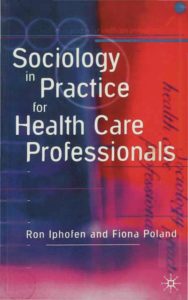
Sociology in Practice for Health Care Professionals
https://www.macmillanihe.com/page/detail/Sociology-in-Practice-for-Health-Care-Professionals/?K=9780333645765
I wrote this with my colleague Fiona Poland when we were both ‘persuading’ health professionals of the value of sociology to their clinical practice. We found that existing texts tended to require readers to pursue the discipline of sociology rather than explore its value to their own professional needs. This is an avowedly introductory text which adopts a cumulative approach – building analytical skills with direct reference to health care examples and linking to readers’ personal and professional experiences. To make it more accessible to a wide range of health professionals we adopted the same active learning approach we used in our teaching – applying sociological insights to health and illness and to health professional practice.