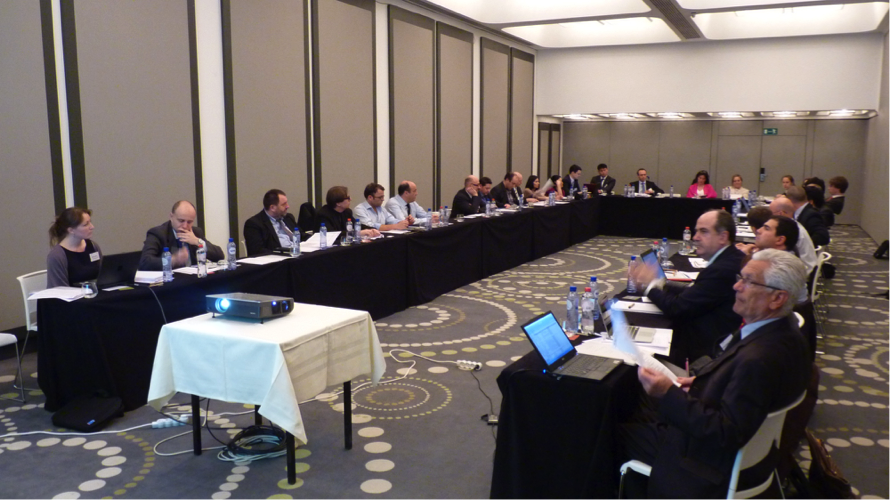
Dr Ron Iphofen – speaking at the European Commission DG Research Workshop on Responsible Research and Innovation in Europe – Brussels, May 2011.
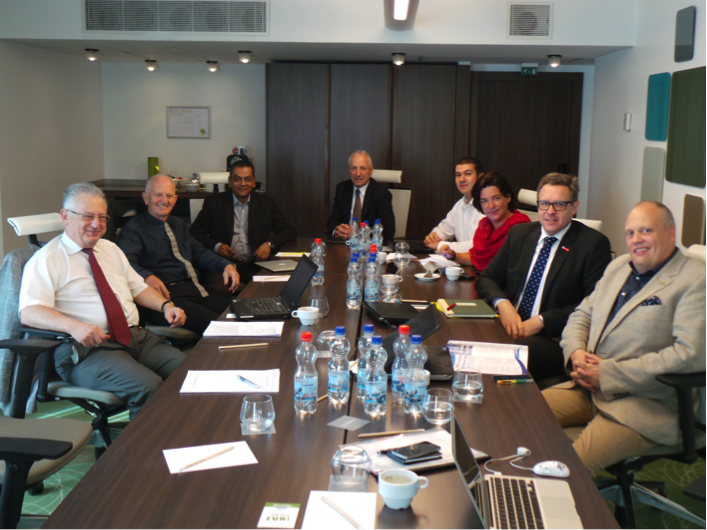
Dr Ron Iphofen at the SECUR-ED Executive Board meeting, Paris, Dec 2014.
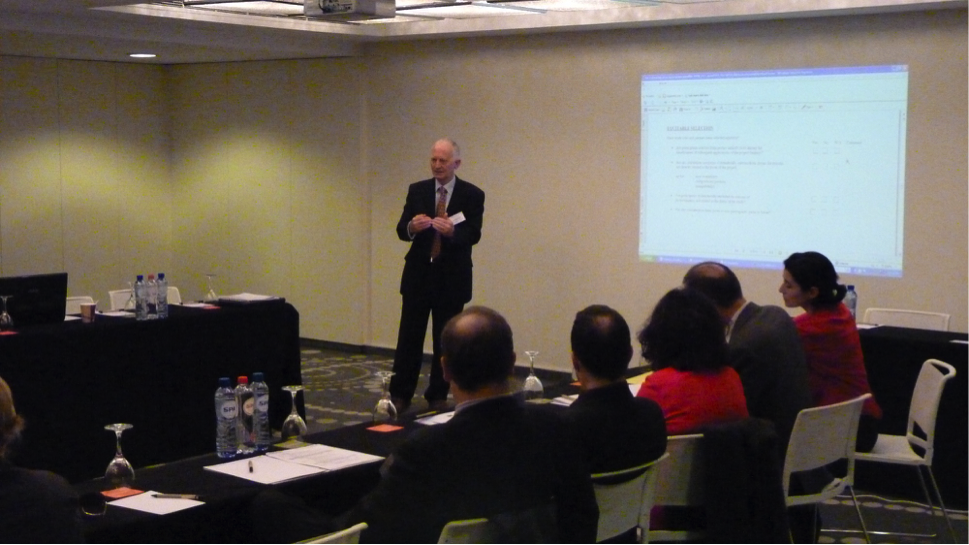
Dr Ron Iphofen Chairing the first meeting of the Ethical and Societal Impact Advisory Group for the SECUR-ED Project (Brussels 2011).
https://msca-participate.eu/
Online bullying has become a global societal problem, disproportionately affecting girls and women, people of colour, LGBTQ+ people, people with disabilities and other protected identity categories. For youth, this problem has become exacerbated during the Covid-19 pandemic, with many learning and social activities moving online. Parents are central to creating a safe and democratic digital world for young people, yet they have been largely excluded from anti-cyberbullying research and actions. PARTICIPATE will bring together Europe’s top experts in anti-cyberbullying to build a research and training network that will:
- Create world-class Early Stage Researchers (ESRs) with transferable multi-disciplinary and intersectoral skills necessary to work with parents, youth, teachers and other professionals to more effectively prevent and reduce cyberbullying across Europe.
- Introduce a vital new dimension into cyberbullying research by investigating the largest group of parents ever studied.
- Harness the knowledge and perspectives being developed in different countries, academic disciplines, youth organisations and technology companies, uniting them in a powerful, strategic collaboration in the fight against cyberbullying in Europe.
- Develop sufficient expertise on parents to create a state-of-the-art toolkit for teachers and other professionals working with parents to prevent cyberbullying.

SPICES project (2017-2021)
SPICES is an acronym for Scaling-up Packages of Interventions for Cardiovascular disease prevention in selected sites in Europe and Sub-Saharan Africa. It is an implementation science project funded by the European Commission through the Horizon2020 research and innovation action.
https://www.uantwerpen.be/en/projects/spices/about-spices/

ERC-ARTIVISM (2016-2021)
ARTIVISM. Art and Activism. Creativity and Performance as Subversive Forms of Political Expression in Super-Diverse Cities.
Super-diversity, creativity and political expression
Artistic expression represents an original way to show political criticism and demand for civil rights. But how do citizens use art in activism or activism in art to create multiple forms of resistance? This project explores new artistic forms of political expression in multicultural cities, in times of crisis and/or in oppressive conditions. Prof. Salzbrunn and her team focus on a broad range of artistic tools, styles, and means of expression such as festive events and parades, cartoons and comics, and street art. Their work is based on multisensory ethnographic research including film-making and drawing in three principal urban settings on three continents: 1. Europe: Italian and French towns with a strong tradition in Carnival parades and carnivalesque style figures (masquerade, détournement) in political demonstrations, 2. Africa: gateway cities in Cameroon with creative and satirical comic art, 3. North-America: Latino immigrant cities in California (US) with powerful mural paintings. Building on urban studies, migration studies, and the anthropology of art and performance, an international team of researchers aims to understand how social actors engage artistically in order to trigger social, economic and political change.
Principal Investigator/Project Leader:
Prof. Dr. Monika Salzbrunn, University of Lausanne (Switzerland)
ERC funding:
Consolidator Grant 2015, EUR 2 million (2016-2021)
Research Associates:
Dr. Raphaela von Weichs, Federica Moretti
Secretary:
Maura Soupper
http://erc-artivism.ch
SuccessfulGovernance (2016-2021)
Success in Public Governance: Assessing and explaining how public problems are sometimes addressed remarkably effectively – PI: Prof. Paul ‘t Hart
Societies cannot survive and thrive if they are not governed well. The public’s business – e.g. security and safety; health and well-being – needs to be managed effectively. Achieving this in the current era of connectivity, transparency, accountability and assertive, skeptical and empowered citizens deeply challenges the institutions of government, which were largely designed for a drastically different era. We urgently need to learn how we can govern societies successfully under the new circumstances. However, in both the popular and academic discourse, the focus is on the frailty and fallibility of our government institutions. We excel in explaining how policies fail, reforms falter, public money is wasted, public leaders are distrusted, and public institutions eroded. So much so that robust knowledge about the practices that produce good governance is hard to come by. And yet good governance is all around us, allowing us to learn from successes as well. This proposal seeks to address the imbalance. It offers a constructive, yet rigorous and systematic investigation of ‘success’ in 21st century governance. An innovative combination of theoretical perspectives, comparative approaches, and mixed methods is developed to answer five questions: 1. How is success in public governance defined and assessed by those who engage in it and those who experience it? 2. Why are some public policies enduringly successful? 3. Why are some public organizations enduringly successful? 4. Why are some interactive, collaborative governance initiatives enduringly successful? 5. How do these successful examples jointly contribute towards understanding the principles of a theory for governance success? The inquiry will increase our insight into the pivotal yet ill-understood phenomenon of governance that ‘works’. It will enrich the field with new methodologies, provoking the discipline to reconsider the emphasis on failure and undertake the systematic study of success.
This project has received funding from the European Research Council (ERC) under the European Union’s Horizon 2020 research and innovation programme (grant agreement No694266)
https://www.successfulpublicgovernance.com
EcoDry IRSES Project (funded by the EU under FP7 from 2013-2017)
This joint exchange project aimed to enhance understanding and share knowledge on strategies to build the resilience of farming systems to natural and man-made impacts in dryland and drought situations, including climate change, through collaboration of joint research and capacity building activities between participating universities.
https://www.coventry.ac.uk/research/research-directories/current-projects/2014/ecodry/
« Context is (nearly) everything where ethical review is concerned »